Preparing for a new wave – How AI shopping agents will shape commerce
Ecommerce is transforming
In January 2026, Stripe announced its partnership with Microsoft Copilot, bringing in-chat purchasing to one of the world’s largest AI platforms.
OpenAI followed suit, providing instant checkout for users in conversations using ChatGPT back in September 2025. Both announcements represent a major development in the way ecommerce happens: AI agents are fast-becoming a new channel of commerce – located between consumer and business, but in ways that did not exist 12 months ago.
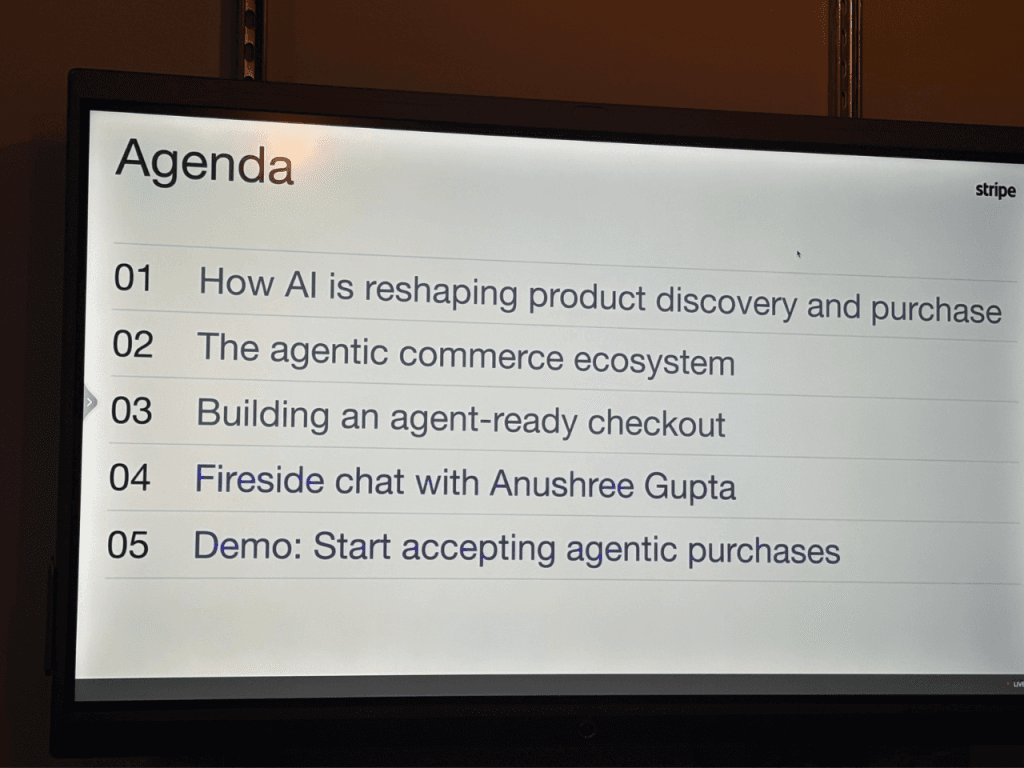
Our team attended a webinar by Stripe earlier this week, called “Preparing your storefront for AI shopping agents”, with the exploration of ‘agentic commerce’ (the new term used to describe the ecosystem of AI platforms such as ChatGPT, Microsoft Copilot, and Google Gemini acting as intermediaries in the purchasing process).
Here’s some key points we took away from the event.
Change is already here
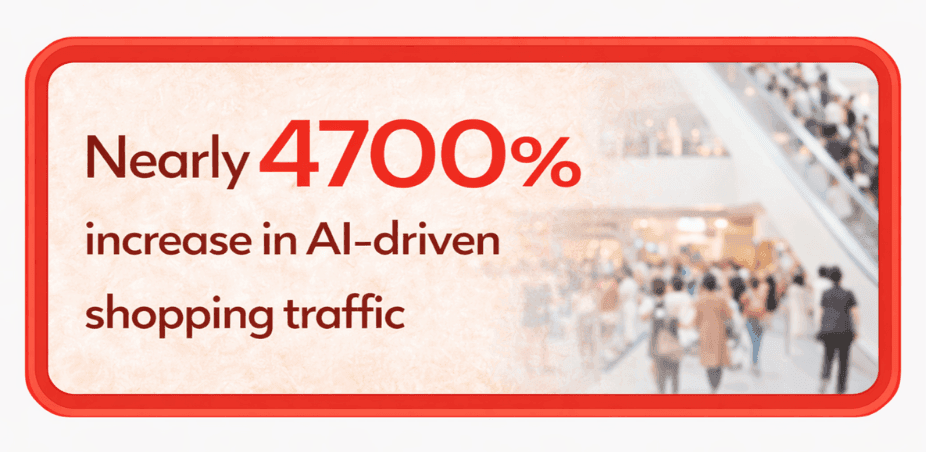
Adobe reported that there was a nearly 4700% increase in traffic to retail websites generated by AI tools, year-over-year, during the 2025 holiday shopping season.
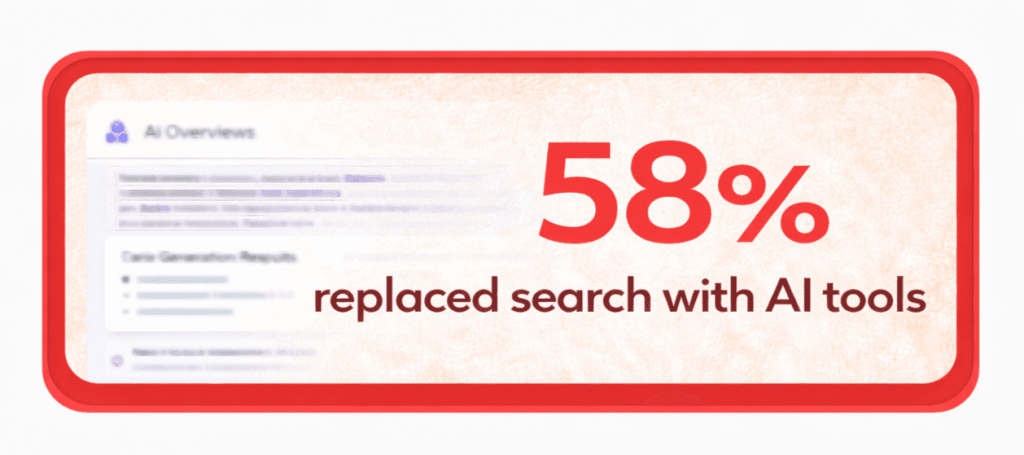
According to CapGemini research, 58% of consumers have already replaced traditional search with AI tools for product recommendations.
There are two reasons why this may be happening.
Firstly, consumers are deliberately using AI tools to do research, like ChatGPT or Perplexity AI. Secondly, consumers may be passively using AI tools to do research (for example, they may type something into Google and receive AI-generated results via Gemini, even if they haven’t asked for them).
However, regardless of whether the usage is active or passive, the trend is clear – the way that consumers are interacting with products and services is changing – and the initial data indicates that many of these interactions are with consumers who are further down the funnel of decision-making than before.
For example, BCG reported that those who arrive from LLMs (Large Language Models) tend to be closer to actual conversion than those who arrive via organic search. Why is this? Because the LLM is often involved in the consumers’ buying journey long before they reach a checkout page. For example, the LLM may have provided a summary of product information; compared reviews; and narrowed down the consumers’ options.
By the time the consumer reaches a checkout page, they have done much of their homework, and are therefore closer to converting.
As Stripe stated during the webinar: “Think about trying to pour through search results looking for reviews. It’s so much easier to let an LLM do all that for you.”
How it really works
The idea behind agentic commerce is relatively simple.
Instead of finding a product through search; clicking through to a website; navigating to a checkout page; and then paying for the product – the whole flow can occur within the AI interface.
ChatGPT’s version allows users to enter the product name, select products, and complete the purchase all in the same session with the AI. The merchant still owns the product, but the AI facilitates the transaction and does not own it.
Microsoft Copilot has taken a similar approach.
Anushree Gupta, Senior Director of AI Commerce Partnerships at Microsoft, described their goal as removing “friction from the middle of the funnel.” Their aim is to enable e-commerce to become more conversational, and allow customers to delegate comparison, evaluation and research to the AI.
Context windows are growing longer.
Users no longer simply search for a product based on keywords. They provide the AI with more context regarding their needs and preferences including parameters and details regarding the product. The AI builds a level of understanding as the conversation develops rather than responding to individual questions. This will change the way merchants consider visibility for their products. Gupta stated that “product content is going to be super important. You need high-quality product feeds with real-time info on pricing, availability, return policy, etc., anything that helps your brand and product stand out.”
A dashboard of agents
In December 2025, Stripe issued their Agentic Commerce Suite (ACS), which is essentially an abstraction layer allowing businesses to connect to various AI agents via one connection point.
This suite seeks to resolve the four problems that brands had raised: maintaining their control as the merchant of record, providing the correct product data to the consumer regardless of the AI interface being used, providing a method to manage numerous connections to different AI agents without creating a separate endpoint for each agent, and mitigating against new forms of fraud.
Microsoft Copilot became the first agent to be completely integrated with this suite in January 2026.
What does this mean to business?
Currently, the Agentic Commerce Suite is only available to selected U.S. retail customers, but other businesses will gain access to it soon. For most businesses, this is clearly in the “wait and see” category as opposed to “take action now.”
However, there are a couple of things that you should consider:
Product content is more important than at any time before
Since the AI agent will synthesise and recommend products based on your product data, the quality of the product data you provide will be a competitive advantage. Real-time pricing, accurate availability, detailed specifications and clear return policies all play a role in whether your products appear in the AI-driven product discovery process.
The middle of the funnel is changing
When a consumer can allow an AI to perform the work of researching and comparing products, the areas in the sales process where brands typically build consideration are changing. Meeting consumers where they are may require meeting them within an AI interface.
Trust is still key
Both Stripe and Microsoft stated that the retailer remains the merchant of record, retains ownership of the relationship with the customer and retains control over the transaction. The AI agents act as facilitators and do not act as intermediaries that would disintermediate the brand. How the balance of power evolves will determine if businesses take advantage of this channel or reject it.
Our view
We attended this webinar to understand emerging distribution channels and how they support our clients’ needs. We are not marketing this today, but we are trying to learn about it so that we are prepared when it is applicable to our clients.
Our honest assessment: agentic commerce is becoming a reality, growing and will matter. However, it is in the early stages, U.S.-centric right now and primarily limited to larger companies that possess the infrastructure and budget to participate.
What gets us excited is the underlying trend. AI is changing how consumers discover and assess products. That has many implications for businesses that go beyond the specific checkout protocol that is in place – it influences content strategies, product placement and how brands engage customers throughout the purchase decision-making process.
We will continue to monitor this space and communicate our findings. For now, the bottom line is straightforward: the way consumers buy is evolving. Understanding that evolution is the initial step to adjusting to it.
Get in touch
Ready to make your brand burn brighter internationally? Let’s talk.
View All Blog Posts →